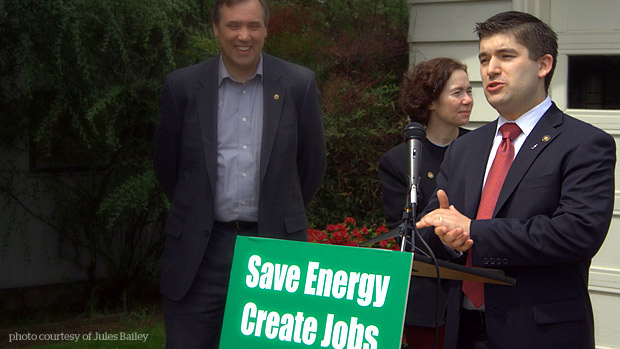
It’s perhaps no surprise that Oregon State Representative Jules Bailey has ended up serving the very district where he was raised by politically progressive parents. The 32-year-old, elected to the Oregon House of Representatives in 2008, says he had “the quintessential Portland upbringing” on Hawthorne Boulevard in the southeast end of the city, where his family preached civic engagement and environmental responsibility.
What may be surprising is that Bailey—now among Oregon’s leading legislators on the environment and job creation—has returned to his hometown a bona-fide Christian. On a rainy December morning in December, Bailey sat in a Portland café wearing jeans and a sweater, recounting his story of coming to faith while sipping locally roasted coffee. “I didn’t grow up in a faith tradition at all,” Bailey said. “My parents weren’t opposed to it; they just believed in letting me figure it out for myself.”
While attending the private Lewis & Clark College to study environmental policy and international affairs, Bailey began reading Dostoyevsky’s sprawling The Brothers Karamazov, the spiritual drama full of ruminations on suffering, free will, and the goodness of God. And it didn’t make much sense to Bailey, who had never read a Bible and had been implicitly taught that faith and intellectual pursuits were separate. He decided to read the Bible cover to cover.
“It was honestly just a literary exercise,” he said. But when he read the New Testament, he realized the Bible was a lot different than he had thought. “It was pure truth,” he said.
After graduating from Lewis & Clark, then working on the Senate election bid for Bill Bradbury, Bailey thought he was through with politics. He earned a master’s in public affairs and urban and regional planning from Princeton, then moved back to Oregon to work for a private economic development firm. “But it wasn’t enough,” he says, “sitting at a desk cranking out spreadsheets and numbers.”
And then, in 2008, his district’s representative moved from the state House to the state Senate, and the seat became available. Bailey’s friends encouraged him to run for office, but he hesitated, and not because he was a new Christian. “Honestly, I didn’t think I was cool enough,” Bailey said, noting that unlike most of his young constituents, he doesn’t have piercings, tattoos, or a customized bicycle. But he was passionate about creating a stable economy and a sustainable environment in his district. What finally convinced him to campaign was the chance to emulate Christ, who was the ultimate servant. “Christ lived to serve us, and he died to save us,” Bailey said. “No matter how much we do for others, we’ll never be able to give as much as he gave to us.”
Since successfully campaigning for the House seat in 2008 and 2010, Bailey’s ability to draft legislation that marries environmental sustainability with innovative job creation has earned wide acclaim. In his first term, he was co-chief sponsor of the Oregon Energy Efficiency and Sustainable Technology (EEAST) act, which provides low-interest financing to home and small-business owners for energy-efficient upgrades. Recipients repay the loans over time with the money the upgrades save them on their utility bills. In his second term, Bailey championed the bipartisan “Cool Schools” bill, a unanimously passed initiative that hires local laborers to perform environmentally friendly upgrades in public school buildings. Schools are able to repay the low- or zero-interest loans using savings from this increased efficiency.
In 2011, Bailey, a fifth-generation Oregonian, was named Innovator of the Year by the Oregon League of Conservation Voters, as well as one of the “35 Innovators under 35” by the nonprofit 1,000 Friends of Oregon.
“I didn’t win because I had great mailers,” Bailey said of his overwhelming victories in 2008 and 2010. “I won because I listened to people. See these calluses on my knuckles?” He holds up his hands. “Most of the houses in my district are old and the doorbells don’t work, so I knocked on ten thousand doors.”
Bailey’s sacrifice goes beyond callused hands. He works 80-hour weeks when the legislature is in session. “And I have to put my environmental consulting company on mothballs,” he said, a move that costs him 75 percent of his potential earnings.
Holding public office is so costly that when Bailey talks to students about a career in politics, he tells them, “If you can imagine yourself being happy doing anything else, go do that.” But for himself, he said, “It’s the only job I can imagine making me happy. This is what I was called to do.”
Bailey credits the influence of a chaplain who met with him weekly in graduate school, as well as Imago Dei Community, the church he’s attended since 2009, with helping him sustain the faith he embraced while reading Dostoyevsky.
Bailey plans to continue his political career for the foreseeable future. In preparation for 2012, he has filed for reelection, and he’s been watching the Independent Film Channel’s comedy series Portlandia. “I learn a lot from it,” he said of the show, now debuting its second season. “It’s like a documentary about my district.”
Bailey says his faith and political career are interconnected—but not in the way many other Christian politicians have comingled the two. “I’ve never prayed to ask God how I should vote on a specific bill,” he said. “But what I do pray for frequently is the ability to put my ego and ambition aside and make the best decision for the people I serve,” he said. “Public policy is a pragmatic issue, but we all approach our jobs with a soul. And that’s what I try to align with the Lord.”
Sarah Thebarge lives and practices medicine in Portland, Oregon. She writes at My Tropic of Cancer, the Burnside Writers Collective, and Her.meneutics, and has written for This Is Our City about fellow Portlander Tom Perez.