For evangelical parents who hold to the church’s long-standing doctrines on gender and sex, waking up to the reality of LGBTQ children in our homes frequently marks the beginning of a difficult journey.
Often blindsided by the development, many parents feel ill-prepared for the work of discernment required to move forward. They hunger for instruction and understanding. Above all, they yearn for relief from the burdensome fear of “getting it wrong” as they navigate uncharted waters requiring many choices, day after day, year after year.
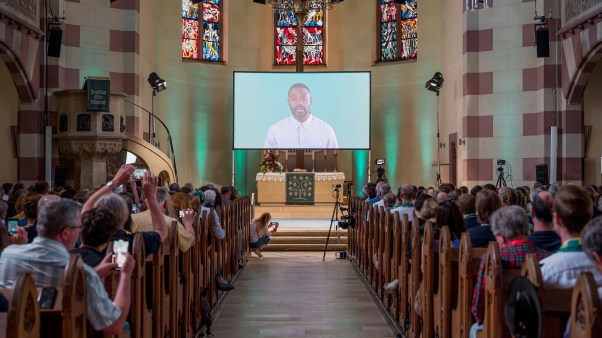
This is the context that produces high turnout for events that try to help Christian parents find responses, beyond fight or flight, to their LGBTQ children—events like last year’s Unconditional Conference hosted by the church of influential pastor Andy Stanley.
The conference was controversial because it featured several speakers who don’t hold orthodox evangelical views on sex and gender. To prominent evangelical critics, the whole affair amounted to “a clear and tragic departure from Biblical Christianity” (Albert Mohler) and a “profound failure of pastoral responsibility” (Sam Allberry).

Similarly, in a more recent dustup, pastor and author Alistair Begg, who holds to the historical doctrine on marriage, saw his popular radio show dropped by a conservative Christian network. It came to light that he’d counseled a woman that she could attend her grandchild’s wedding to a transgender person, though she opposed the union on doctrinal grounds. Writing for First Things, theologian Carl Trueman argued that attending such a wedding is itself a doctrinal drift and “a very high price tag for avoiding hurting someone’s feelings. And if Christians still think it worth paying, the future of the Church is bleak indeed.”
As an evangelical parent of adult LGBTQ children myself, I followed both controversies with interest. I share some of the detractors’ concerns, but I also believe that we American evangelicals who hold fast to Christianity’s historical doctrines on sex and gender—the traditional or “non-affirming” position, per current lexical shorthand—need more, not less, conversation about the intensely practical questions of how to be good neighbors to the LGBTQ people in our lives, be they in our homes, workplaces, or congregations.
There are some resources available for Christians in my circumstance, like Allberry’s Is God Anti-Gay? and the course for parents from The Center for Faith, Sexuality & Gender. But beyond books or online courses, we need real-life conversations about specific circumstances. Christian parents of LGBTQ kids, like me, thirst for a sustainable vision of day-to-day life with our children. There’s certainly grounds to criticize the vision offered by Stanley and Begg, but simply restating right doctrine, while necessary, isn’t alone enough to answer those questions of practice, of how to live with our children.
As parents, we’re already rooted in the understanding that God created humanity in two distinct forms that we call male and female, and that sexual intimacy is reserved for monogamous marriage between a man and a woman. Our question is how to relate to our children, especially adult children, when they choose lives not rooted in that understanding.
We’ve made clear to them what we believe. Now what?
I suspect that much of the reaction to Unconditional and Begg is the result of worry that open consideration of these prudential questions will inevitably result in significant theological drift with dire consequences for the church and for those to whom it ministers. It’s a fear amplified by a culture war mentality, which has been present in evangelicalism since the fundamentalist-modernist controversies of the early 20th century. This mentality tends to cast LGBTQ people as our enemies in that fight, enemies to be constantly confronted with statements of truth.

It is good to speak truth, yet adopting a permanently confrontational posture makes it impossible for us to heed the apostle Paul’s exhortation to the Roman Christians: “So far as it depends on you, live peaceably with all” (Rom. 12:18, ESV). And while searching for answers to these practical questions of relationship has, for many, been but a stop on a journey away from orthodoxy, that’s not the only possible outcome.
The task at hand is one of correct practice (orthopraxy), which requires discernment, and discernment is a naturally fraught enterprise. What makes it fraught, of course, is our fallibility. For while God’s Word is wholly trustworthy, our application of it may not be. Sometimes we choose to be lenient when we should be firm, or severe when we should be flexible. Regardless of our spiritual diligence and good intentions, there’s always a chance we will make the wrong choice. Add to this the sobering awareness that even correct choices can result in pain for those we love, and discernment becomes downright daunting.
But ignoring the reality that discernment is necessary is not an option. The presence of risk does not exempt us from doing the work of loving our neighbors. People need help, and decisions need to be made: Should Christians use preferred pronouns? Should we attend the same-sex weddings of our children or coworkers? Should we allow our adult children in same-sex marriages to sleep in the same bed when they come to visit?
For many of us, these are not mere academic exercises but real situations with real people demanding answers, often without much lead time. These are the circumstances in which we must practice discernment, applying what we know from God’s Word to the best of our ability, with great care and humility. These are the kinds of questions Christian parents like me (and grandparents, as in the case Begg addressed) long to have in-person help answering in conversations with our pastors and friends at church.
Sometimes we will get it wrong. Sometimes, as J. I. Packer put it in his seminal work, Knowing God, a “Christian wakes up to the fact that he has missed God’s guidance and taken the wrong way.” But even then, the damage is not irrevocable, Packer assured, and God is gracious enough to protect his sheep—including us—from our own fallible thinking. “Thus,” Packer concluded, “it appears that the right context for discussing [divine] guidance is one of confidence in the God who will not let us ruin our souls.”
Discernment requires hard work, much prayer, biblical reflection, and testing of spirits (1 John 4:1–6). Doing this in a culture with a rapidly shifting Overton window is incredibly difficult. But having to do so in isolation because fellow orthodox evangelicals are unwilling to talk through the practical questions is even worse.
Victor Clemente is a freelance writer on faith and culture issues. His work has appeared in Christ and Pop Culture and Faithfully Magazine. Find him on X at @The_Wait_Room or Threads at @the_wait_rm.