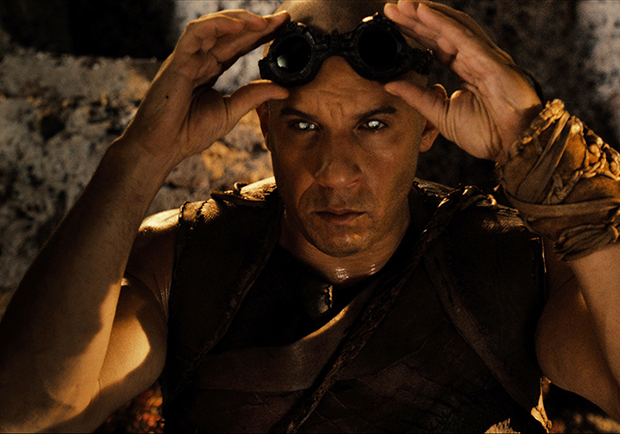
In his book Culture Making, Andy Crouch (also CT's executive editor) gives some criteria for thinking about cultural goods. Culture, says Crouch, is "what we make of the world"—or, better yet, "how we make sense of the world by making something of the world"—and so we can start with this question: What does the cultural artifact assume about the world, and what does it assume about the way the world should be?
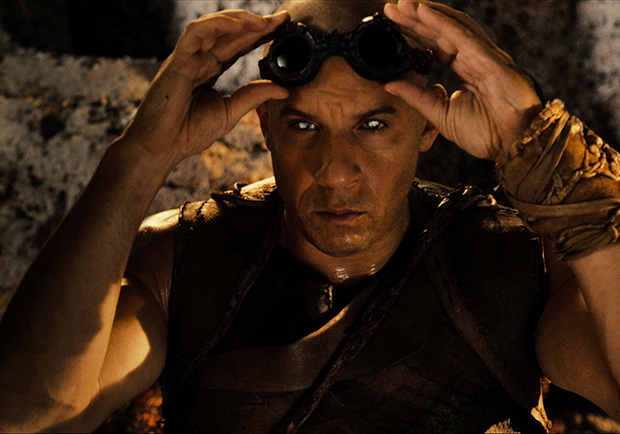
By this rubric, David Twohy's new sci-fi action thriller, Riddick, the third installment in the Chronicles of Riddick franchise, doesn't hold up well. Aesthetics aside (a whole other problem), the film's universe is tainted and sinister, void of justice and morality, and epitomized in its anti-hero, Riddick (the brutal Vin Diesel). And there's no way to resolve this bleak reality: you just embrace and survive it. As Ignatiy Vishnevetsky observes in his review for The A.V. Club, Riddick "refuses to pretend that he's anything more than an animal."
 2013 / Universal Pictures
In the deliberate and brooding opening sequence of Riddick, Twohy actually teases us into thinking there may be more to his protagonist—and his movie. These initial moments feature the film's sleekest images and visual effects: the ferocious Riddick drags his injured body across a vast and desolate landscape filled with dark caves and boiling pools of water, mowing down CGI beasts with just an animal bone. But they also hint at the only humanity threaded into the story, especially in Diesel's solemn narration, an element that invokes a number of contributions from tech-noir.
That promise fades fast. Riddick strangely and laughably befriends a wild CGI zebra-dog. But then we get caught up on the backstory and find out how exactly Riddick wound up on the lonely planet: in an apparently blissful time before the dark circumstances, the drunken Riddick stands above a bed of four naked women begging him to come back to them. This is a preview at the twisted vision that follows—a confused understanding of sexuality and a dehumanizing depiction of women.
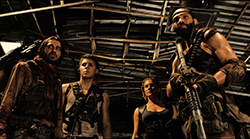
It all devolves into one big aesthetic and moral vacuum, a battle between two evils without any meaning or sense of justice. Two teams of bounty hunters soon catch wind of Riddick's remote location and show up, looking to take off his head. That naturally turns into a predictable game of cat and mouse, muddled by bad CGI and several disjointed action sequences plus a few humorous moments, thanks to some ridiculous one-liners from the ensemble of B-actors, including Jordi Molla and Katee Sackhoff of Battlestar Galactica.
Amid the chaos, Sackhoff's Dahl emerges as a sexualized lesbian who, at one point, brags, "I don't f*** guys, but I occasionally f***** up." Yet, her character exists solely to give the male characters (and, presumably, the audience) an object over which to lust, from a topless shower shot to Riddick's persistent chatter about getting her into bed (though he, of course, uses far more graphic language).
 2013 / Universal Pictures
Riddick culminates into a big and bloody battle that forces Riddick to ally with his enemies in order to survive a massive attack of gruesome alien creatures that only come out in the rain. But by this point, we've already seen it all. Somehow, watching Diesel take out an unrealistic amount of monsters, over and over and over again, makes it all repetitive and dull.
Some might argue that the amorality epitomizes a B genre movie—a distorted sexuality, objectification of women, evil vs. evil. Dahl more or less does what she's supposed to do within the confines of the genre she's found herself in.
But if that is the case, maybe the problem is less Riddick, more what its genre assumes about the world, and about the way the world should be, and about the dignity of its characters (and its audience, too). Crouch argues that the only way to change culture is to make more of it—better artifacts to replace the lesser ones. Maybe it's possible to make a Riddick-style movie that isn't, in the end, just a vacuous aesthetic wasteland set in a morally twisted universe. But it looks like it's up to a director with more imagination than Twohy to figure out how.
Caveat Spectator
Riddick is rated R for strong violence, language and some sexual content/nudity. It's is violent and bloody from beginning to end. The most graphic of these scenes is one in which Riddick kicks a machete and it slices a man's head off. The characters use profanity and obscenities loosely and excessively, including the f-word numerous times. In the first half of the film, we see four women completely nude in bed. In the middle of film, the character of Dahl is seen showering.
David Roark lives in Dallas and works as a creative director and freelance writer. You can follow him on Twitter at @DavidRoark.