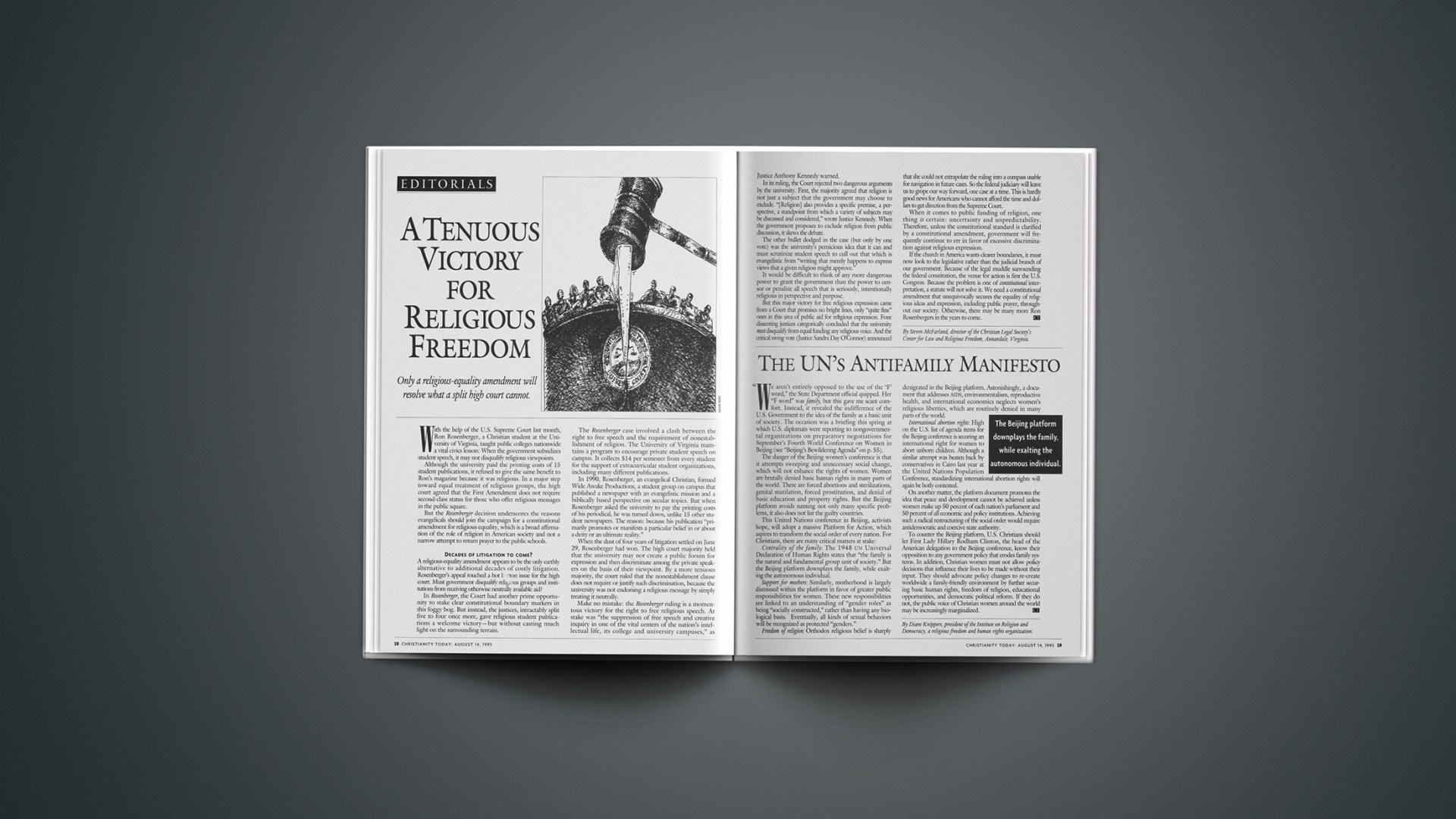

With the help of the U.S. Supreme Court last month, Ron Rosenberger, a Christian student at the University of Virginia, taught public colleges nationwide a vital civics lesson: When the government subsidizes student speech, it may not disqualify religious viewpoints.
Although the university paid the printing costs of 15 student publications, it refused to give the same benefit to Ron's magazine because it was religious. In a major step toward equal treatment of religious groups, the high court agreed that the First Amendment does not require second-class status for those who offer religious messages in the public square.
But the Rosenberger decision underscores the reasons evangelicals should join the campaign for a constitutional amendment for religious equality, which is a broad affirmation of the role of religion in American society and not a narrow attempt to return prayer to the public schools.
Decades of litigation to come?
A religious-equality amendment appears to be the only earthly alternative to additional decades of costly litigation. Rosenberger's appeal touched a hot button issue for the high court. Must government disqualify religious groups and institutions from receiving otherwise neutrally available aid?
In Rosenberger, the Court had another prime opportunity to stake clear constitutional boundary markers in this foggy bog. But instead, the justices, intractably split five to four once more, gave religious student publications a welcome victory-but without casting much light on the surrounding terrain.
The Rosenberger case involved a clash between the right to free speech and the requirement of nonestablishment of religion. The University of Virginia maintains a program to encourage private student speech on campus. It collects $14 per semester from every student for the support of extracurricular student organizations, including many different publications.
In 1990, Rosenberger, an evangelical Christian, formed Wide Awake Productions, a student group on campus that published a newspaper with an evangelistic mission and a biblically based perspective on secular topics. But when Rosenberger asked the university to pay the printing costs of his periodical, he was turned down, unlike 15 other student newspapers. The reason: because his publication "primarily promotes or manifests a particular belief in or about a deity or an ultimate reality."
When the dust of four years of litigation settled on June 29, Rosenberger had won. The high court majority held that the university may not create a public forum for expression and then discriminate among the private speakers on the basis of their viewpoint. By a more tenuous majority, the court ruled that the nonestablishment clause does not require or justify such discrimination, because the university was not endorsing a religious message by simply treating it neutrally.
Make no mistake: the Rosenberger ruling is a momentous victory for the right to free religious speech. At stake was "the suppression of free speech and creative inquiry in one of the vital centers of the nation's intellectual life, its college and university campuses," as Justice Anthony Kennedy warned.
In its ruling, the Court rejected two dangerous arguments by the university. First, the majority agreed that religion is not just a subject that the government may choose to exclude. "[Religion] also provides a specific premise, a perspective, a standpoint from which a variety of subjects may be discussed and considered," wrote Justice Kennedy. When the government proposes to exclude religion from public discussion, it skews the debate.
The other bullet dodged in the case (but only by one vote) was the university's pernicious idea that it can and must scrutinize student speech to cull out that which is evangelistic from "writing that merely happens to express views that a given religion might approve."
It would be difficult to think of any more dangerous power to grant the government than the power to censor or penalize all speech that is seriously, intentionally religious in perspective and purpose.
But this major victory for free religious expression came from a Court that promises no bright lines, only "quite fine" ones in this area of public aid for religious expression. Four dissenting justices categorically concluded that the university must disqualify from equal funding any religious voice. And the critical swing vote (Justice Sandra Day O'Connor) announced that she could not extrapolate the ruling into a compass usable for navigation in future cases. So the federal judiciary will leave us to grope our way forward, one case at a time. This is hardly good news for Americans who cannot afford the time and dollars to get direction from the Supreme Court.
When it comes to public funding of religion, one thing is certain: uncertainty and unpredictability. Therefore, unless the constitutional standard is clarified by a constitutional amendment, government will frequently continue to err in favor of excessive discrimination against religious expression.
If the church in America wants clearer boundaries, it must now look to the legislative rather than the judicial branch of our government. Because of the legal muddle surrounding the federal constitution, the venue for action is first the U.S. Congress. Because the problem is one of constitutional interpretation, a statute will not solve it. We need a constitutional amendment that unequivocally secures the equality of religious ideas and expression, including public prayer, throughout our society. Otherwise, there may be many more Ron Rosenbergers in the years to come.
By Steven McFarland, director of the Christian Legal Society's Center for Law and Religious Freedom, Annandale, Virginia.
Copyright © 1995 Christianity Today. Click for reprint information.
ctcurrtk5T90185814