What’s wrong with the world? It seems literally impossible to say. Instead, I find myself wildly gesturing, throwing my hands around to indicate anything and everything. Skyrocketing debt, declining wages, flatlining church attendance, and wars and speculations of wars: It’s hard to know where to begin.

The problem for many of us is not merely that the world is out of control. It’s that we frequently feel forced to act in that world in ways we know to be unjust.
For millennia, poets and prophets have tried to name this experience of being put in an impossible moral situation and—importantly—required to act against one’s own conscience. In the aftermath of the Vietnam War, psychologists began to call it moral injury. Veterans returning from war, they observed, had undergone both physical and mental trauma, for they’d been ordered to do things that violated their own moral intuitions. Moral injury came to name a whole collection of experiences linked to these violations: guilt, shame, remorse, and loss of trust in authority that had commanded them to do wicked things.
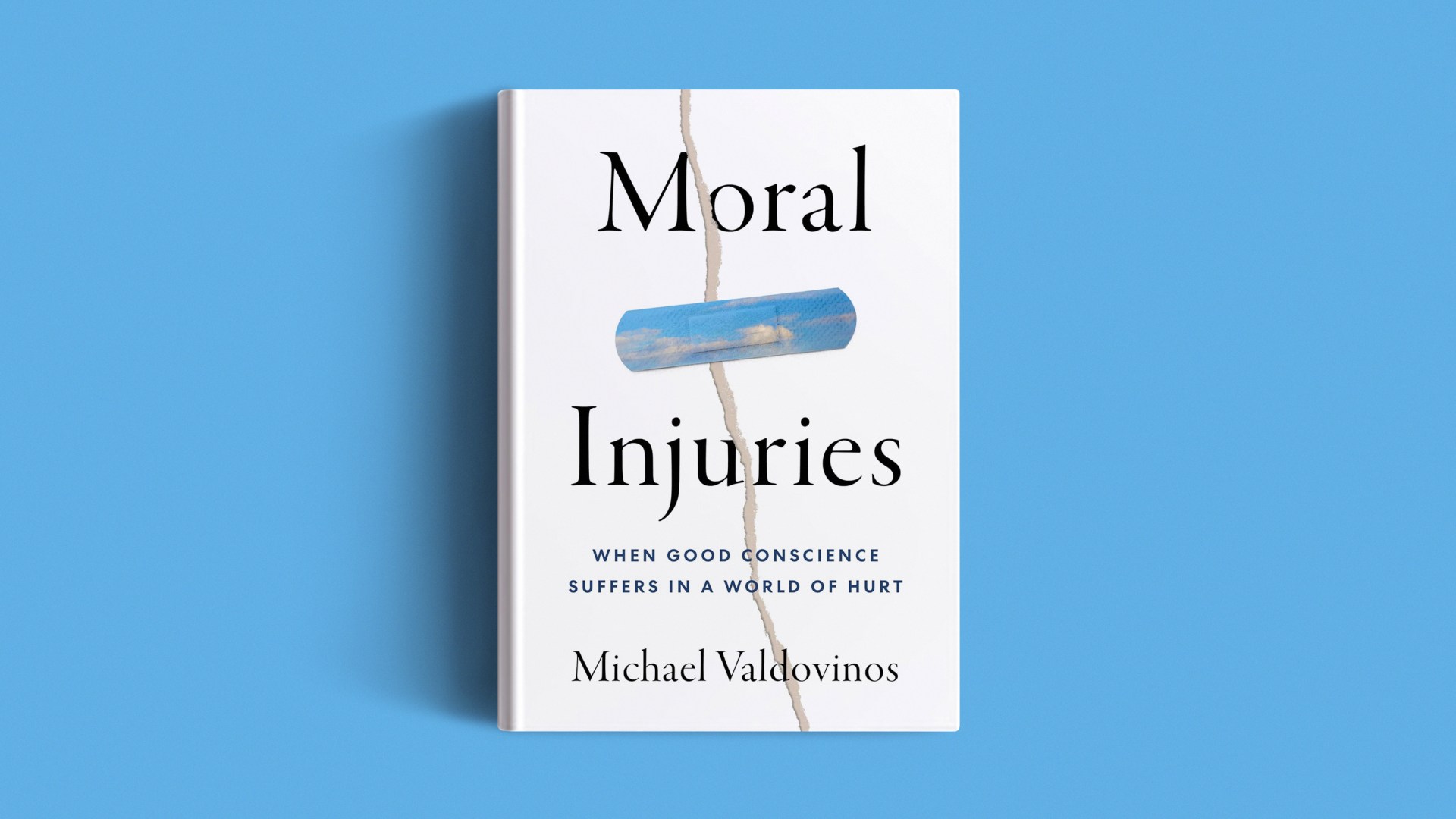
Since the 1990s, application of the term has expanded beyond veterans to encompass any number of situations in which people are forced into a conflict between their beliefs and behavior. And the symptoms of moral injury—including detachment, constant second-guessing and attempts to atone, and thoughts of self-harm—are nothing to be trifled with. It is this phenomenon that Michael Valdovinos examines in Moral Injuries: When Good Conscience Suffers in a World of Hurt, not only to explain but also to alleviate.
Valdovinos’s work focuses on moral injury as a neurobiological reality. Others have examined it with lenses of philosophy or theology, but Valdovinos—as a clinical psychologist—wants us to attend to what moral injury does to our bodies. Like other psychological phenomena, moral injury affects what our bodies are doing: how they’re trained to stay or flee in the face of threats. When we think one way and are forced to act another, our bodies receive mixed messages, Valdovinos writes, even at the biological level.
By sticking with the biological dimensions of our actions, Valdovinos offers a helpful corrective to many popular accounts of the moral life. Too often these amount to little more than Do the right thing! or in Christian circles Just follow Jesus! The will to be good or to be a disciple is important, of course. But we follow God as human creatures with complex psychologies and bodies that don’t always want what is good for reasons involving hormones, neurons, and other physical elements that are only so much under our control. Ethics are for people called to live moral lives in physical bodies, a detail Christian accounts too often forget.
This being said, the problems of Valdovinos’s book begin early and occur often, always linking back to what we mean by moral.
Valdovinos follows the American Psychological Association’s definition, which says moral has to do with “experiences that disrupt one’s understanding of right and wrong, or sense of goodness of oneself, others or institutions.” These experiences indicate a rupture within our sense of self, so moral injury is a violation of “our deepest values—our core moral identity—that … leaves us feeling like an irredeemably bad person.” Moral injury in this definition is a deeply subjective breach in which someone’s personal code conflicts with coercive structures.
related


As Valdovinos generally presents it, the substance of that moral code is less important than whether a person has one. Simply having a strong conviction that doesn’t fit your circumstances is enough for moral injury to occur. At one point, Valdovino identifies the three pillars of morality—respect, relationship, and reciprocity—but this does little to clarify what we’re talking about, because morality in his definition first and foremost serves to provide integrity to a person’s life. But what might count as respectful behavior for one person could look like cold disinterest to another; what for me is meant as reciprocity may seem like coercion to someone else.
If morality is, in the end, nothing more than a code that holds me together, it’s not a subject for serious discussion or debate. It amounts to something like niceness. And anything trying provide some weightier definition to the moral life—say, Christianity—is reckoned by Valdovinos a bad-faith institution, claiming a divine mandate to “safeguard society’s moral and spiritual purity by conducting inquisitions.” It was the Enlightenment, he argues, that saved the world from the benighted moral postures of the “Big Gods.”
This thin definition of morality hides a deeper problem: For Valdovinos, morality is evolutionary biology writ large. At numerous points in the book, he describes respect, relationship, and reciprocity as mere products of evolutionary processes that allowed humans to form complex societies. Moral instincts he likewise casts as the result of evolutionary change in which “loners would die out, while those who stuck together learned that cooperation led to both longer life and strength in numbers.” Valdovinos consistently overplays his evolutionary hand, stating at one point that our DNA determines the degree to which our moral traits function.
That account aligns with a perspective made popular by best-selling psychologist Jonathan Haidt, for whom morality is only our brains’ attempts to rationalize our gut reactions. And behind both is the 18th-century philosopher David Hume, who argued that our moral language is an attempt to cope with reality, that whenever we say something ought to be, we’re really just trying to make sense with language of what our gut intuitions are saying.
related


For all three writers, the upshot is that morality is our subjective feelings, with reason filling in the gaps between our desires and the facts on the ground. But for Valdovinos, feelings are extensions of our DNA—listening to your gut is more than a figure of speech here. If I say something isn’t right, in his thinking, that’s just a fancy way of saying my DNA is mismatched for the world in which I live.
That’s far from hopeful for those suffering moral injury: Not only are they in conflict with the world around them, but also, in Valdovinos’s framework, there’s no immediate way to end that conflict.
The result is what seems to be an impossible situation for those suffering from having violated their consciences. If our morality is a function of our individual biology, these people cannot share their moral world with others. And if societies are simply collective enactments of evolutionary instincts, those struggling cannot hope society will change to align with their instincts.
In the final chapters, Valdovinos proposes strategies to help people suffering from moral injury to move forward, away from their feelings of guilt and estrangement. But these are cold comfort, for the best people can hope for is to cope well with a mismatch without resolution.


As a way of talking about a specific kind of harm that happens to people in our world, moral injury is a genuinely helpful concept that can facilitate necessary and important work. But by reducing morality to our biological impulses, Moral Injuries puts it beyond reason or hope of change. Morality here becomes, ironically, something that further estranges us, an individual quirk of personality and biology that isn’t suitable for discussion, advocacy, or argument.
If only there were another account of morality to which all people are summoned regardless of biology (Gal. 3:28), in which the weak and the strong live together in grace (1 Cor. 8). If only there were an account that looks forward to the transformation of our mortal bodies (1 Cor. 15) and teaches how our wills, minds, and affections can be changed (Rom. 12:1–2). If only there were an account of morality that could draw us into a community in which we might not just cope with our pasts but be forgiven.
Myles Werntz is the author of Contesting the Body of Christ: Ecclesiology’s Revolutionary Century. He writes at Taking Off and Landing and teaches at Abilene Christian University.
Related