As evangelical christians living at the dawn of the 21st century, we often lack a method and a language for addressing the challenges of our current age. Yes, we have the will and the passion to defend our faith, the biblical knowledge to support our arguments, and often the Christian charity to couch those arguments in love. Yet for all our passion, knowledge, and love, something in our approach is lacking; something about our vocabulary is deficient. We seem powerless to convict, engage, and transform the secular world. Consider three examples:
The word reaches our churches, colleges, and seminaries that a resurgence of paganism is sweeping the country, that New Age philosophies are rampant and that the serious worship of Sophia (Greek for wisdom) is chanted in the not-so-hidden recesses of our mainline denominations, and we are unsure of how to respond. Many evangelicals can expose the heresies that lie behind such practices; of apologists we have no lack. But how adept are we at identifying the deeper spiritual needs that the New Age seems to be meeting? How well-versed are we in the tenets of paganism and their challenge to the early church? And how well do we understand that the mythical corn god of pagan ritual represents a yearning that should end its fulfillment in the historical, incarnate God of the Bible?
The scientific community joins forces with the academy and the media to ridicule us for our belief in God's creation of the world, and perhaps to sigh together in disbelief that modern, educated men and women could accept as literal events the miracles recorded in the Bible. Certainly we've gotten better at answering such critiques; we tend to be less insular than we were in the past, and we sometimes manage to move from defensiveness to shaping the debate. But we're still fighting our battles on "their" turf, on a scientific and philosophical groundwork that was defined during the Enlightenment and all but completed by the end of the Victorian Age. Scientists such as Michael Behe have done a remarkable job at countering modernists' data, and law professor Philip Johnson has exposed the flaws in their logic, but we've yet to shift the playing field from the theories to the competing assumptions that underlie those theories. We've yet to educate ourselves, much less the culture, that many of the "givens" we take for granted (most notably, that the foundation of all true knowledge is material, empirical, and quantifiable) are as recent as they are unproven.
The modern and postmodern literati are fast dethroning language and the arts as bearers of divine meaning—or, for that matter, of any meaning. As Christians we answer by producing our own works of art: some of them original masterpieces of lasting value, but most of them short-lived cannon fodder for a Christian subculture with plenty of surplus capital. But, again, we persist in speaking their language, in accepting their dichotomies, their theories, their values. The few literary and theoretical critiques we do produce are often too arcane to reach a broader public, and tend to be intimidated by, and even adulatory of, the academy they are critiquing.
A brave few are breaking from this tendency and are championing a more traditional view of art that is grounded in the Incarnation. However, the necessary link between what happened once for all in a stable at Bethlehem and what occurs on a lesser level in the creation and appreciation of great art is little explored by evangelical critics and even less put into practice by evangelical artists.
At first glance these three examples may seem wholly unrelated: the first, after all, concerns theological issues, while the second and third are philosophical and aesthetic in focus and scope. But look a little closer. In all three cases, we catch a glimpse of a church that knows how to address the symptoms but seems to lack the will to face the disease head on, that prunes the stunted branches so nicely while remaining oblivious to the rotting of the roots.
We need to dig deeper to reach those unstated assumptions that gird and control our contemporary world, even as we must broaden our perspective to encompass both the multifaceted nature of the modernist and postmodernist ethos and the equally multifaceted critique that we as evangelicals must offer in response. But where shall we find the methods and the language to construct such a critique?
An Apologist Steeped in Myth
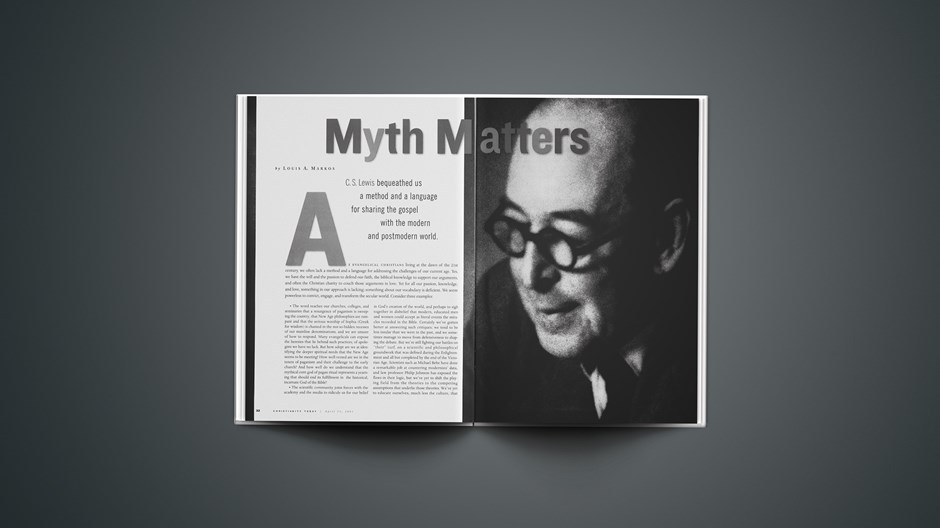
The 20th century, which saw the full flowering and wide dissemination of modernist thought, also produced one of modernism's greatest and most enduring critics: C. S. Lewis. Born in Belfast in 1898, Lewis spent the first half of his life as an atheist and a materialist for whom the Gospels shared the same mythic-archetypal (nonhistorical) status as Greek and Norse mythology but lacked their aesthetic beauty and imaginative power. Though the young Lewis loved all things Homeric and Wagnerian, and though he went through a brief period in which he lusted after occult knowledge and idolized the more esoteric poetry of William Butler Yeats, his natural temperament was that of a skeptic and a stoic. He distrusted thinking that was either emotionally charged (like that of his estranged father) or logically imprecise, and tended to isolate himself in a pristine world of books.
Article continues below
This twin propensity for intellectual precision and emotional self-protection grew during the early years of World War I, when the shy, unathletic Lewis (who bitterly hated the boarding school he was attending) got the chance to study under a private tutor. His tutor, William Kirkpatrick (or the Great Knock, as Lewis called him) was an obsessively rational thinker of that old and venerable school of skeptical Scotch empiricists of whom David Hume is the titular head. From the very moment Lewis arrived at Great Bookham, Surrey, Kirkpatrick beat into his head the need for clear, rational thinking free from all subjective speculation and emotional murkiness. Thus, when the nervous, fledgling Lewis, desperate to make conversation, noted that Surrey was less "wild" than he had expected, Kirkpatrick subjected him to an immediate, deadly serious inquisition about the basis of his statement. The inquisition did not last long; it quickly became apparent to Lewis that, as his expectations of Surrey were wholly unfounded, and as he did not even know what he meant by the word wild, his statement was both illogical and meaningless and had best be dropped.
Most students would have crumbled under such relentless logic; to Lewis (who later retold the story in his spiritual autobiography, Surprised by Joy) it was "red beef and strong beer." Lewis committed himself to absolute clarity of thought and to assessing the assumptions on which our ideas are based.
Ironically, though Kirkpatrick was an atheist, he was partly responsible for shaping the critical faculties of the 20th century's greatest Christian apologist. When Lewis, after many years of intellectual soul-searching, finally embraced Christian orthodoxy in 1931, he did not simply jettison his early mental training for an emotional, pietistic faith. Rather, he marshaled the full forces of his mind in defending what he called "mere" Christianity (the central doctrines of the Apostles' Creed that all believing Christians share). In such works as Mere Christianity, Miracles, The Abolition of Man, and The Problem of Pain, Lewis directly challenged the modernist faith in the all-pervasive explanatory power of evolution, asserting that such things as ethics, religion, and reason could not have evolved but must have had a divine origin. Unlike so many contemporary Christian academics who passively (if not unconsciously) accept the existing assumptions on which their discipline is based and then meekly ask that God's name be mentioned now and then, Lewis went on the offensive and challenged the assumptions themselves.
Article continues below
Had Lewis brought to Christian apologetics only his skills as a logician, his works would not have been as effective. The mature Lewis tempered his logic with a love for beauty, wonder, and magic. His conversion to Christ not only freed his mind from the bonds of a narrow stoicism; it freed his heart to embrace fully his earlier passion for mythology. During his overly rational years, Lewis felt the need to submerge his youthful love for fairy stories; his newfound faith in a God-Man who died and rose again reopened for him the enchanted world of his childhood. Apart from this dash of fairy dust, Lewis might have become yet another dry, overly systematic thinker (an Aristotle or Aquinas); instead, he speaks to us with all the power and life-changing force of a Plato, a Dante, and a Bunyan. Nearly all of Lewis's insights into the Christian faith can be traced back to a comment made by one of the church fathers or one of the medieval scholastics, but then these commentaries are seldom read, except by specialists, while Lewis's works continue to sell, challenge, and convict in the millions.
A Universe Alive with God's Presence
Lewis understood both the heart that yearns for God and the mind that seeks to know him. Just as Plato's greatest dialogues begin with a logical defense of, say, the immortality of the soul, and then end with a myth in which that rather stale doctrine leaps into vital life, so Lewis was never content merely to prove the existence of God or defend the necessity of a key Christian doctrine. Yes, Lewis will provide us with the scholastic proof, and he will do so in what Wordsworth called "the real language of men," but he will not let us rest until we acknowledge and feel the overwhelming reality and presence of that God whom Lewis describes, variously, as the hunter, the lover, and the bridegroom.
Evangelicals often find it difficult to respond to the growing power of the New Age in all its many combinations and permutations. Many of us attended schools where mythology was more or less off-limits and where paganism as a system of thought was neither explained nor even acknowledged. But then, of course, there is a surprise here. Most of the young people who are slowly gravitating toward some form of New Age spirituality are themselves ignorant of paganism's classical past. They sense within themselves a spiritual vacuum and turn toward the only venue that seems to be speaking their language.
Article continues below
Often their decision to abandon traditional Christianity for the mystical allures of neopaganism stems less from an informed rejection of doctrine than from a dissatisfaction with the modernist world and its exclusive focus on objective, empirical knowledge. To their minds, modernism has killed nature and silenced the universe, and the church has done nothing to restore the cosmos to life. Here is an irony. In the Middle Ages, Christians held a view of the universe as a place teeming with life and meaning and purpose. Though the best informed of the theologians steered clear of any rigid determinism that would find our fates written indelibly in the stars, they nevertheless knew that the stars do have something to do with us and that the God-fashioned cosmos was not just our house but our home. Certainly St. Francis of Assisi knew this, and he celebrated it in his "Canticle of Brother Sun."
We post-Reformation, post-Enlightenment Christians are too often uncomfortable with such nature talk. On the one hand, we fear that our doctrines will become diluted with pagan elements, that Christianity will fade into the realm of myth. On the other hand, we are suspicious of any language that resembles pantheism—not so much because we are Christians as because we are children of a modernist world that has defined nature as a thing to be studied rather than loved, and the unseen world as a non-thing to be explained away or, better, ignored. Our fears are not totally baseless, but fears they are, and they often prevent us from understanding the deep hunger that draws so many into the precincts of the New Age.
Lewis can help us address our fears and fashion a more effective response that strikes more closely at the root of the problem. Lewis's approach, which surfaces throughout his published works, is essentially twofold. As a literary theorist and aesthetic historian whose works still command respect in the secular academic world, Lewis was responsible for rehabilitating the reputation of medieval literature and for explaining in lay terms the intricacies of the medieval cosmic model that undergirds Dante's Divine Comedy. Those interested in the minutiae of this model are encouraged to read Lewis's The Discarded Image, but if you have already read his Chronicles of Narnia or his Space Trilogy, you have already absorbed much of this model. Lewis saw the need not only to explain and defend the medieval model but to embody it, to give it form and substance, in his fictional works.
Article continues below
Our age cannot adequately answer the New Age critique of modernist science and religion because so few of us know how it feels to live in a universe that is alive with its Father's presence. Lewis steeped himself in that more vibrant, old-European world that stretches from the ancient Greeks to Samuel Johnson; indeed, he argued that the Renaissance never happened, that the reigning view of God, man, and the universe did not change (as is so often taught) when the ancient Greek texts were rediscovered around 1500 but when the Enlightenment finally established itself around 1800. In a famous phrase, Lewis compared himself to a dinosaur, to one who still believed, embodied, and felt in his bones the ideals, the values, and the worldview that invigorate the work of such Christian poets as Dante, Chaucer, Spenser, Donne, and Milton. Much has been written in the last decade (and praise God for it) of the need for evangelicals to engage their minds more fully; Lewis would direct us toward another kind of renewed engagement: the revival of our capacity for wonder. If we are to win back the neopagans, we need to rediscover our awe at the majesty of God and his Creation, an awe that has little to do with the current warfare over worship styles and everything to do with that breathless sense of the numinous that we first encountered in the nursery when a timeless tale from mythology or folklore or legend ushered us into the world of faerie.
The Myth That Is Fact
But this renewal of wonder represents only one prong of a Lewis-inspired response to the New Age. It is not enough only to revive the part of us that yearns for myths; we must also channel it properly. One of Lewis's greatest services as an apologist was to demonstrate that in the person of Christ we encounter a figure whose life, death, and resurrection, far from standing in opposition to the mythic heroes of paganism, in fact present a literal, historical fulfillment of what all those earlier myths were really about. To put it another way, just as Christ came not to abolish the Law but to fulfill it, so he came not to put an end to myth but to take all that is most essential in the myth up into himself and make it real. In "Myth Became Fact," a seminal essay anthologized in God in the Dock, Lewis argues forcibly that
Article continues below
[t]he heart of Christianity is a myth which is also a fact. The old myth of the Dying God, without ceasing to be myth, comes down from the heaven of legend and imagination to the earth of history. It happens—at a particular date, in a particular place, followed by definable historical consequences. We pass from a Balder or an Osiris, dying nobody knows when or where, to a historical Person crucified (it is all in order) under Pontius Pilate. By becoming fact it does not cease to be myth: that is the miracle. … God is more than god, not less: Christ is more than Balder, not less. We must not be ashamed of the mythical radiance resting on our theology. We must not be nervous about "parallels" and "pagan Christs": they ought to be there—it would be a stumbling block if they weren't. We must not, in false spirituality, withhold our imaginative welcome. If God chooses to be mythopoeic—and is not the sky itself a myth—shall we refuse to be mythopathic?
If we could understand fully all that is suggested in this passage and apply it to our interactions with neopaganism, we would find ourselves better able to address the needs of a growing segment of our society. As evangelicals, we are quick to say with Paul that we are not ashamed of the gospel; let that boldness include not only the doctrinal elements of the Good News, but also its elements that answer the questions posted by great myths.
The urge to return to paganism is not so much an offshoot of modernist thought as it is a reaction against modernism's narrow focus on the material world. This puts Christians in the precarious position of criticizing the excesses of New Age thought while yet participating in its central goal of restoring a spiritual focus to a society that generally resists any serious consideration of the supernatural.
We have to walk a fine line between the twin extremes of secular humanism and gnostic spiritualism; between a deistic ethos that doubts either that God speaks to or intervenes in the world (in any case, he has no Son) and a more pantheistic ethos that rather blissfully asserts that we are all the mouths and eyes and hands of God. Perhaps these two opposing sides of the modernist coin can help explain why the academy is absolutist in its denial of the scientific or rational validity of all faith claims that rest on revelation yet is strongly relativistic in gauging personal ethical decisions.
Article continues below
I allude partly to a phenomenon that has come to be known as the failure of the Enlightenment Project: the failure of philosophers like Kant to refound all morality on rational (rather than supernatural) grounds. Such Christian thinkers as Alisdair MacIntyre, Lesslie Newbigin, and Mark Noll have done a fine job demonstrating how this seemingly noble attempt to "save" morality by giving it a more "secure" basis has only resulted in a split between science and religion, facts and values, history and myth, observation and faith; this split has marginalized the voice of Christianity in the public sphere and rendered its doctrines, its perspectives, and its claims suspect. The efforts made by Christian scholars in this area are, I think, exhilarating and are helping point the church in the right direction; here too, however, we can still learn much from Lewis's apologetic approach.
Exposing Inductive Reasoning
Just as Lewis was adept at delving into the roots of paganism and properly assessing where those roots are compatible with those of Christianity, so was he equally adept at exposing the presuppositions upon which modernism stands. Lewis begins by pointing out something most apologists since have failed to take into account: that while traditional Western/Christian philosophy rests on deductive logic, modernist thought systems (from science to anthropology, economics to psychology) claim to rest exclusively on induction. Induction is a kind of reasoning that begins with observed facts and figures and then proceeds upward toward a more abstract hypothesis or inference, while deduction begins with abstract premises and general assumptions and works its way downward toward a specific conclusion.
Christian thought (like the Platonic metaphysics that preceded it) is deductive, for it begins with a priori assumptions that must be accepted as givens before logical thought can begin (e.g., the existence of God, the authority of Scripture, the immortality of the soul, the possibility and reliability of divine revelation). In contrast, modernism claims that its conclusions are based solely on empirical observation, that its conclusions are "objective," unrestrained by any presuppositions.
Article continues below
Again and again in his writings, Lewis seeks to expose modernist induction for what it most often is: a disguised form of deduction. When a liberal theologian argues that the Synoptic Gospels (all of which include Jesus' prophecy of the destruction of the Temple) must have reached their final form after A.D. 70 (the year the Temple was destroyed), he is obscuring an assumption (namely, that predictive prophecy does not occur) that acts as a motivating and controlling factor in his research. Likewise, modernists who continually seek "natural" or "rational" explanations for the miracles of the Bible do not begin their research objectively and then conclude (solely on the basis of their observations) that the parting of the Red Sea was not a supernatural event; rather, they begin with the unproved "given" that miracles don't occur and thus are forced by their own presuppositions to formulate a "scientific" explanation for the miracle.
Despite the exalted claims of modernist induction, Lewis writes in the first chapter of Miracles, when it comes to the supernatural, "seeing is not believing. … What we learn from experience depends on the kind of philosophy we bring to experience. … The result of our historical enquiries thus depends on the philosophical views [i.e., the a priori assumptions] which we have been holding before we even begin to look at the evidence."
Viewed alone, this passage might suggest that Lewis was a proto-postmodernist, one who would deconstruct all truth claims by exposing their insecure (and unfounded) assumptions. He was not. If he did some demolishing of modernist pretensions to the truth, it was only so that he (like Socrates and Plato) could follow this dialectical housecleaning with a renewed effort to redefine the true nature and origin of man, of religion, and of reality itself.
Indeed, in this vein, one of Lewis's most important critiques of modernism involved his questioning of the modernist assumption that higher things are always copies of lower things, such as Marx's claim that ideology merely reflects underlying economic forces; Darwin's belief that more complex forms of life (like humans) evolved from lower, less complex structures; and, most important for Lewis, Freud's insistence that love and charity are but a sublimated form of lust. Much of Lewis's creative and apologetic energy (in both his fiction and nonfiction) was devoted to demonstrating that lower things are, in fact, copies of higher, that heaven is the real place and our world but the shadow.
Article continues below
The Word Made Fiction
While evangelicals have garnered many victories in resisting contemporary anti-Christian worldviews, one area has not received enough attention from evangelical circles: aesthetics. Yes, we are quite aware of the ethical dangers of postmodernism and deconstruction; we're good at "sniffing out" Nietzsche, and events like the Columbine shootings have taught us that value-free education quickly leads to nihilism. We realize too that to attack the meaningfulness of language is finally to attack both the Scriptures and the classic creeds. But what often lies just outside our Christian radar is the threat that postmodern theories pose to the integrity of the arts.
Such theories (that begin with the linguistic studies of Ferdinand de Saussure and reach their climax in the essays of Jacques Derrida) hold that the words we use are not embodiments of real ideas or essences but merely "sound images" (signifiers) that point back to some shadowy concept (signified); worse yet, the relationship between these signifiers and signifieds is wholly arbitrary. To such thinkers, not only is the Incarnation of Christ an impossibility; any claim that a physical word or image can somehow contain a pre-existent, transcendent, or even stable meaning is illusory.
Thus poetry, which has long held a high status as a near-prophetic genre with the power to embody higher truths, is dethroned, and any faith that the poem might point us upward toward some eternal, unchanging center of reality is exploded. A book, says French theorist Roland Barthes, is but a "tissue of signs, endless imitation, infinitely postponed." Indeed, any time we as readers think we have discovered a stable center of meaning, we soon find that what we thought was a center is just another signifier pointing in another direction.
For this reason, and several others that are more political and cultural in scope, the status of the Great Books of the Western Tradition has been under continual attack in our leading secular universities. Such a deconstruction of our tradition poses a major threat to Christianity; yet many evangelical Protestants choose to ignore this threat and to focus only on defending the integrity of the Bible.
Article continues below
I might add here that every time Christianity Today has published an issue devoted to fiction, it has received numerous letters from sincere Christians who are indignant that CT should waste its time on fiction when there are more pressing matters, like theology, to attend to. This is not surprising given that Protestantism has never fully exorcised a lurking, semi-Islamic spirit of iconoclasm that is suspicious of all "graven images" (whether in word or picture). In this sense, Western Catholicism and Eastern Orthodoxy have done a better job at defending and nurturing the arts; indeed, the Orthodox, who defend the sacred status of their icons by arguing that when the Word became flesh it baptized physical matter as a potential container for divine presence, are particularly well-situated to mount a defense of the arts that is radically incarnational in its focus.
And, of course, the Incarnation is precisely the place where we must start if we are to defend the traditional capacity of the arts to embody meaning and truth. The church is not wholly deficient in this arena. Annie Dillard, Frederick Buechner, and Madeleine L'Engle have all been hard at work, and the last decade has produced at least three fine collections edited by Gregory Wolfe (The New Religious Humanists, 1997), Andrew A. Tadie and Michael H. Macdonald (Permanent Things, 1995), and Philip Yancey (Reality and the Vision, 1990) that attempt the right kind of dialogue between Christianity and the arts.
Still, the nagging thought lingers that Christians (particularly evangelicals) are not serious about restoring the status of the arts, or, to get more practical, that they are perfectly willing to accept a radically polarized literary world in which there is secular fiction (purged of all Christian meaning) on the one side, and overtly and unsubtly Christian fiction on the other. Do we really desire a fiction in which humanism and Christianity, Athens and Jerusalem, can meet? Do we really yearn for a kind of poetry that, though written from a Christian worldview, does not offer simple, prepackaged meaning? Do we really herald the return of Donne, Milton, Coleridge, Browning, Dostoyevsky, Hopkins, and O'Connor? Is our answer to postmodernism and deconstruction to be that fiction should either not be taken seriously as a vehicle for divine truth or that it should shun all slipperiness and merely offer a thinly veiled sermon? Why can't we rise above our modern aesthetic naysayers to fashion a literature that, while replete with irony, paradox, and ambiguity, can yet assert (not in spite of but by means of its metaphors and symbols) the existence and reality of transcendent truths? After all, are not the Incarnation and the Trinity paradoxes of cosmic proportion?
Article continues below
All of this leads to the sad admission that the Christian world has yet to produce a true successor to Lewis in the hybrid genre of popular/serious, Christian/secular fiction (a category, incidentally, that includes Dante, Chaucer, and Spenser). Any potential successor would do well to learn the elements of The Chronicles of Narnia that render these novels a veritable blueprint for that incarnational aesthetic our age so desperately needs.
As Lewis often said, the Narnia novels are not allegories; the characters and incidents do not function simply as pictures whose sole purpose is to illustrate Christian virtues or vices (as they do in Pilgrim's Progress). Rather, they possess their own separate life and integrity (many have read the Chronicles without being aware of their Christian message). Yes, Aslan is a symbol of Christ, but he is also a very real lion who has his own history, his own reality, his own metaphysical status. Even so was the Virgin Mary an average rustic girl who also happened to bear in her womb all the fullness of God's presence.
Though the Chronicles do function as testaments to Christian truths, Lewis did not set out to write a book that would do so. He began with images (a faun carrying an umbrella, a queen in a sledge, a noble lion) that he wanted to embody, then found a genre (the children's story) that would enable him do so, then (and only then) considered how those images and that genre could be used as a vehicle for "smuggling" Christian principles into a post-Christian age.
The Chronicles incorporate stories and figures from a number of different traditions (both Christian and pagan); rather than attempt to synthesize these traditions in a systematic way, Lewis forges a deeper link that plays on the almost unconscious reactions we have to mythic archetypes. The result is to render the spirit of Christ an integral part not only of our theological and philosophical beliefs but of our individual and cultural dreams.
Aslan is a type of Christ not only because he does and says many of the things that Christ said and did but because he inspires in us the same kind of numinous awe that Christ does. When we read of how Aslan was sacrificed on the Stone Table, we receive more than a theological primer of the Crucifixion; we actually experience, viscerally, the pain and sorrow of Calvary. In his apologetics, Lewis uses words to defend Christian doctrines; in his fiction the Word becomes flesh. In Aslan, Christ is made tangible, knowable, real.
Article continues below
Louis A. Markos is an associate professor of English at Houston Baptist University. The Teaching Company (www.teach12.com) released his audio and video course, The Life and Writings of C. S. Lewis, in 2000.
A ready-to-download Bible Study on this article is available at ChristianBibleStudies.com. These unique Bible studies use articles from current issues of Christianity Today to prompt thought-provoking discussions in adult Sunday school classes or small groups.
Christianity Today sister publication Books & Culture published in 1998 a headier article on Lewis's relevance in postmodernism: "C. S. Lewis Among the Postmodernists | How to be a perspectivalist without losing your foundations."
On the one-hundredth anniversary of Lewis's birth, Christianity Today ran an article by J.I. Packer titled "Still Surprised by Lewis | Why this nonevangelical Oxford don has become our patron saint" (Sept. 7, 1998)
See also our earlier story, "Jack Is Back | The search for the historical Lewis" (Feb. 3, 1997) as well as articles on what C.S. Lewis wrote about Botticelli, Christmas, and other topics.
If it's Lewis you're interested in, Into the Wardrobe should fill your every desire.
The Discovery Institute's C.S. Lewis and Public Life site is another wonderful resource of papers about and by Lewis.













 The apostle Paul’s discussion of same-sex sexuality in 1 Corinthians 6 is a clear, compassionate, and proportionate model for church leaders.
 French evangelicals are working together to show people Jesus at 2024 Olympic Games.Français